Link in Bio vs Website: When You Don't Need Both
Most people who think they need a website actually need a bio page.
A website implies infrastructure — hosting, domain, design, development, ongoing maintenance. For a brand with a content archive, a product catalogue with hundreds of SKUs, or a blog with years of posts, that infrastructure makes sense. For a blogger, a small business, a freelancer, or a creator whose entire online presence lives in their social feeds — a website is often a project that gets started, half-finished, and gradually ignored.
A bio page costs nothing and takes two minutes. It collects every link, shows the work, lists the services, answers the questions. For a significant portion of the people who assume they need a website, a well-built bio page is sufficient — and it's a fraction of the cost and effort to maintain.
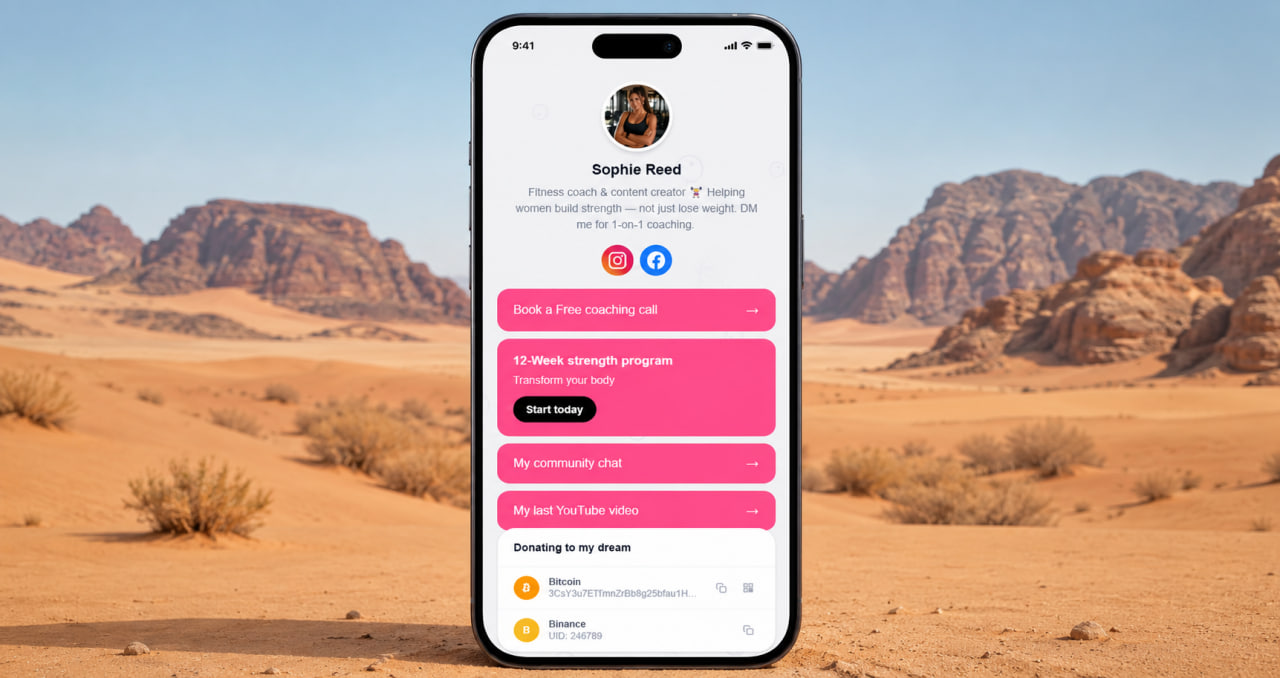
When a bio page replaces a website entirely
If your online presence is primarily social — you post on Instagram, TikTok, YouTube, or a combination — your audience is already there. They don't need a website to find you. They need a single address that collects everything they'd want after finding you on social: your other platforms, your shop, your booking link, your contact, your best work in a gallery. That's a bio page.
The calculation is simple: website costs 2-3x more in time and money than a bio page. For every creator or small business that doesn't have the budget or the inclination to maintain a proper website, a bio page does 80% of the same job at a fraction of the cost. It loads faster, it's easier to update, it works better on mobile, and it requires no developer when something needs to change. For most people, that's the right tool.
Build your bio page free — skip the website overhead
Gallery, services, FAQ, products. 2 minutes to build. No hosting. No maintenance.
Get started free →When you actually need a website
A website makes sense when the content or commerce is too deep for a bio page. An e-commerce store with hundreds of products and a checkout flow needs a proper platform. A blog with years of archive and SEO-driven traffic needs a CMS. A SaaS product needs a full marketing site. A large agency needs a site that communicates institutional depth.
For everyone else — and that's most people — a bio page handles the job. The creator who posts daily doesn't need a website that nobody visits. The small business whose customers find them on Instagram doesn't need a Shopify store for five products. The freelancer whose portfolio lives on Behance doesn't need a personal site as well. The bio page is the address. Everything behind it does the work the website would have done.
ClickInk — the bio page that replaces a website for most people
Gallery, products, services, FAQ. 2-3x cheaper than a website. Free to start.
Try free →Start with the bio page. Add the website when you actually need it.
The bio page is the right starting point for almost everyone. It costs nothing, takes minutes to build, and does the essential job — connecting your audience to everything you do. If you grow to the point where it isn't enough, you'll know it. The signs are specific: too many products for a catalog, too much content for a link list, traffic that requires SEO infrastructure. Until those signs appear, the bio page is sufficient. And "sufficient" means you can focus on the work instead of maintaining infrastructure that isn't pulling its weight. ClickInk has no link limits, no ads, no watermarks. 35 languages. Free to start. Build the page today and reassess the website question in six months.
Your page at click.ink/yourname
Free to start. No credit card. No hosting. No maintenance. Just works.
Create your page now →